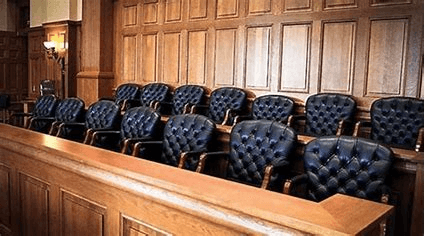
Trial by a jury of your peers has been a right valued in the United States for decades. And while a lot of folks don’t like serving on a jury, the fact is that jury service is a civic duty everyone is entitled to be a part of, regardless of their personal political beliefs.
Moreover, the jury selection process is geared toward having a fair and unbiased trial. Attorneys on both sides go through a process allowing them to dismiss jurors who are biased, or who simply can’t be fair to both parties. However, a recent case, called People v. Clark, potentially undermines the ability of individuals to perform their civic duty to serve on a jury.
Case Background
“Voir Dire” is a Latin term that means the process of questioning and possibly striking jurors before they are placed on the jury for a case. You have probably seen the process play out in the movies. Attorneys are allowed to ask prospective jurors a variety of questions to determine what biases they have, including whether they harbor any racial bias. Over the course of the process, attorneys have limited “strikes” (called peremptory challenges) they can use to dismiss a candidate without a stated reason. However, because of the limited number of peremptory challenges each side gets, attorneys often attempt to dismiss prospective jurors “for-cause.”
These “for cause” challenges rely on a judge’s determination that a prospective juror cannot serve fairly. Of course, harboring racial bias is one way a juror can’t serve fairly. And it is the trial judge’s duty to analyze the juror’s responses to certain questions, and to determine whether the “for-cause” challenge should be granted. If a judge does not grant the request, the challenging attorney must either accept the individual as a juror or go ahead and use a peremptory challenge to remove them from the jury pool.
In the case of People v. Clark, the Colorado Supreme Court is considering whether a trial court judge erred by not excluding a juror who made comments that he opposed the concept of “diversity.” In denying a for-cause challenge to the juror, the trial judge ruled that Juror K’s comments opposing diversity were not evidence of racial prejudice, because opposition to diversity is merely a political belief. The prospective juror also indicated he would be impartial during the trial. Having lost the “for-cause” challenge, Clark’s attorney then used a peremptory strike to remove the prospective juror.
After being sentenced to 30 years in jail, Clark appealed, arguing that the denial of the “for-cause” strike tainted the trial, and violated the right not to have a juror who harbors racial animosity against a defendant. The Colorado appellate court rejected the appeal, on a 2-1 vote, but on different grounds. It agreed with Clark that the juror *did* harbor racial bias against him, based on his statements about diversity, but also held that it didn’t matter, because the juror didn’t ultimately serve on the jury. Clark again appealed his conviction to the Colorado Supreme Court, where the case sits currently.
Now at the Colorado Supreme Court, both Clark and the prosecution are assuming that the prospective juror did in fact harbor racial bias when he spoke out against diversity. But that assumption is improper. That’s why Mountain States Legal Foundation is offering an amicus brief arguing that the trial judge did not make an error, and that there are plenty of reasons why reasonable people of good faith might oppose diversity, and not be racists. Simply put, we argue that opposition to diversity is not sufficient grounds to find actual bias, and that the Colorado Supreme Court should uphold the trial judge’s decision.
What’s At Stake
We are urging the Colorado Supreme Court reject any argument equating racial bias with mere opposition to diversity. Otherwise, countless Colorado citizens might be excluded from juries, given the commonly held negative views associated with “diversity,” and its close cousin, “equity.” These concepts are themselves often used to justify race discrimination, and the Supreme Court recently rejected the idea that race discrimination in college admissions is constitutional, if done in the name of “diversity.”
Furthermore, a negative ruling from the Colorado Supreme Court would lead to strategic questioning from attorneys, in order to extract certain kinds of statements from jurors, so that they have a reason to remove them from the jury. This would ultimately harm the judicial process as a whole. We urge the Colorado Supreme Court to recognize in their opinion that the only reason a juror should be dismissed by a for-cause challenge is if they have demonstrated actual racial bias for or against a party.
Mountain States has filed an amicus brief in this case because we believe in protecting a fair judicial system, and the right of any citizen to hold a viewpoint opposed to diversity. If that were not the law, it would raise serious questions under the First Amendment’s right to free speech, and the Sixth Amendment’s right to an impartial jury.
The bottom line is that people can oppose diversity for legitimate reasons, without being racists. In this amicus brief, we point out that this case is an opportunity to reject any insinuation otherwise.
Join the Fight
Since 1977, MSLF has fought to protect private property rights, individual liberties, and economic freedom. MSLF is a nonprofit public interest legal foundation. We represent clients pro bono and receive no government funding. Make your 100% tax deductible contribution today and join the fight.
You can read an Op-Ed article written by Will Trachman about the People v. Clark case at the link below Opinion: Must we affirm support of “diversity” to serve on a jury? (coloradosun.com)
