
In the United States, should our government conserve large swaths of land for the benefit of public use? That question is loaded. Which governments? Which tracts of land? What is “public use?” I can’t pretend to answer all of those questions in a single post or even in multiple posts. What I can say is that the conservationist movement—begun largely as a noble endeavor by the likes of Theodore Roosevelt to balance industry and wildlife—of today is not concerned with finding solutions to human-nature interactions. It is much more interested in stopping all human involvement in nature.
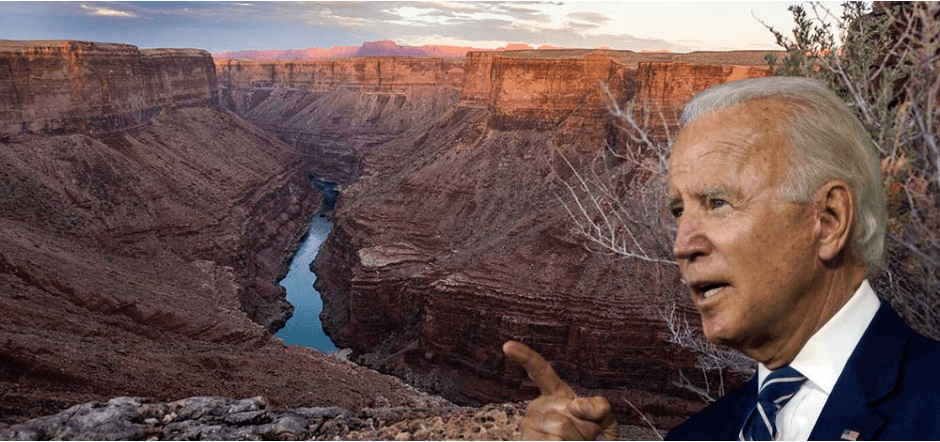
Take a recent edict by President Joe Biden. In the visually stunning and physically rugged landscapes of Arizona, where natural beauty and untapped resources converge, a heated debate is brewing over his recent naming of the Baaj Nwaavjo I’tah Kukveni Grand Canyon National Monument. On the surface, it may seem like a noble move to protect such areas, but a deeper look reveals a combination of superficial “environmental” chauvinism and political motives.
Conflicting Goals
At the heart of the controversy is President Biden’s decision to prevent mining on nearly one million acres of uranium-rich land. While the Administration’s intentions are painted as part of a broader push for clean energy and conservation, the motivations behind such a move raise questions about the priorities of big-government interest groups who cloak their motives as environmental and indigenous-heritage concerns.
Biden’s commitment to preserving 30 percent of the nation’s lands and waters by 2030 is beyond ambitious, and it is being pursued at the expense of clean energy generation. The uranium deposits of Northern Arizona are touted as a unique source of clean nuclear energy, providing a substantial chunk of both the United States’ electricity and carbon-free power. Yet, the Administration’s actions appear to be more focused on curbing human activity altogether than on harnessing clean energy potential.
Little Regard for Multiple-Use
This situation is a stark reminder of how government intervention can sometimes obscure the path to sensible solutions. The multiple-use mandate that Congress wrote into federal law—a principle aimed at balancing the utilization of federal lands for various purposes, including energy production, recreation, and conservation—seems to have been cast aside in favor of a one-size-fits-all approach to big government. It reflects the ever-expanding administrative state’s determination to touch almost every aspect of our daily lives and the will of the big-government interest groups who cloak their intentions in a purported “environmentalism” and care for indigenous heritage.
For example, the push to protect indigenous heritage and sacred lands is a sensitive subject, and should be approached carefully. However, it is disheartening to see how often this cause becomes entangled with political agendas. While our federal government can and should acknowledge indigenous heritage, including special places for religious ceremonies and other practices, the decision to designate this specific monument (and thus cut off any other use) raises questions about whether sound public policy and scientific considerations were truly taken into account.
Political Priorities
It’s hard to ignore the role of political cronies in shaping decisions that impact the delicate balance between environmental preservation, protection of indigenous heritage, the federal mandate that multiple uses be allowed on public lands, and economic opportunity. The debate over the Grand Canyon monument echoes the sentiment that these decisions are often driven more by political connections than by a genuine commitment to the well-being of local communities, indigenous heritage, the environment, and the rule of law.
What’s particularly frustrating about the Grand Canyon monument is that it pits these crucial priorities against each other when they should be mutually reinforcing. Instead of an either-or scenario, we should be pursuing policies that support indigenous heritage while also harnessing our energy potential. This requires a commitment to fact-based decision-making, where science and the needs of local communities take precedence over political convenience.
A Better Stewardship
Big-government activists also often make preserving the environment and generating energy an either-or situation: Can we truly protect our natural treasures while fostering economic growth? We do not buy into that false dichotomy. As Mountain States has learned first-hand in representing ranchers, other producers, recreationists, and other stewards of public lands, the best path to preserving our beautiful lands is through property rights and economic interests. Viable solutions lie at the intersection of responsible resource management and the utilization of clean energy sources. Blanket decisions that prevent (in this case) responsible mining for a clean-energy future and so many other uses of public lands can hinder economic growth and job creation, leaving communities in the lurch.
The Grand Canyon monument saga serves as a reminder that the pursuit of true, non-chauvinist environmental preservation must be rooted in pragmatic, science-driven policies rather than knee-jerk reactions, and should celebrate the American traditions of common purpose, excellence, and hard work rather than the desire for centralized and far-away government control over every aspect of our lives. Protecting the landscapes that define our nation doesn’t have to come at the expense of energy opportunities—including clean-energy opportunities—and economic growth. By prioritizing smart resource management through property rights and embracing clean-energy solutions, we can strike a balance that benefits our environment, our futures, our indigenous heritages, and our communities.
Mountain States’ Committment
In the end, the questions remain: Are we truly committed to preserving our natural wonders and supporting clean energy, or are these priorities just convenient tools in the hands of political agendas? The Grand Canyon monument controversy should prompt us to reflect on the role of government, the value of responsible resource utilization, and the importance of putting sound policy and science ahead of political games.
At Mountain States, we remain committed to fighting for a better and truer environmentalism, one grounded in our constitutionally protected liberties and practical stewardship. Going to court—whether directly for clients, as intervenors, or writing amicus briefs—is how to ensure that chauvinists do not have the final say in defining public policy for public lands.