An Educator with Purpose
Zack De Piero didn’t become a teacher for prestige or accolades. He did it because he believed in the power of language to change lives.
From his earliest days teaching English and Language Arts in Philadelphia’s inner-city schools, Zack made it his mission to help struggling students—many of them from underprivileged backgrounds—find their voice. Later, he pursued a Ph.D. in Education at UC Santa Barbara to better serve future students and expand his reach.
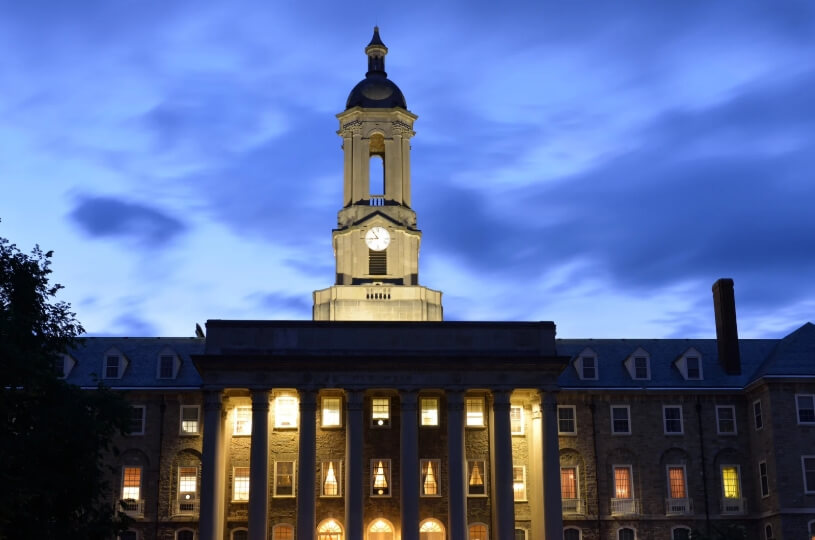
In 2018, Penn State Abington hired Zack as an Professor of English and Composition. It seemed like a natural next step for an educator with a passion for helping students rise. But what followed was something no one could have anticipated.
Join the Fight
Since 1977, MSLF has fought to protect private property rights, individual liberties, and economic freedom. MSLF is a nonprofit public interest legal foundation. We represent clients pro bono and receive no government funding. Make your 100% tax deductible contribution today and join the fight.
By 2020, the climate at Penn State began to shift dramatically. Faculty meetings and professional development sessions were increasingly consumed by radical ideology and divisive rhetoric. Penn State administrators and faculty promoted materials claiming that non-white students were incapable of meeting standards of quality in writing, which were “white supremacist” anyway, and instructing teachers to give up even trying to help. It trained staff instead that “white teachers are a problem,” that “white culture” was a barrier to student success, and that simply being a white teacher in a classroom was a form of harm. It aggressively pursued affirmative action policies to replace as many of its white employees as it could. Zack was told to engage with these materials until “he got it”—and warned not to take offense.
The message was chilling: If you’re white, your very presence is the problem. And if you question that message, you are standing in the way of “anti-racism” and “justice.”
Zack tried to stay focused on his students. But as the pressure grew, he could no longer keep quiet. He raised concerns with his supervisors, questioning how he could solve the “problem” of being a “white teacher” given that he could not change his skin color. He published an Op Ed letting the outside world know that Penn State was short-changing its students by abandoning standards and writing fundamentals. He spoke up during staff trainings, asking specific and respectful questions about how he could help students succeed in the face of Penn State’s sweeping generalizations and raising concerns that Penn State was violating the law. The retaliation was swift.
Instead of honest discussion, he was met with silence—or worse. His department chair filed formal complaints against him, accusing Zack of “microaggressions” and “bullying” because he dared to question the wisdom and legality of Penn State’s practices.
Eventually, Zack’s job evaluations suffered, his relationships with colleagues soured, and his future in academia dimmed. In 2022, after years of enduring a racially hostile work environment and repeated retaliation for simply exercising his fundamental right to discuss public education and employment policies, Zack was driven to resign.
But he refused to walk away quietly.
Zack filed suit against Penn State, alleging that the University had violated his civil rights by creating a racially hostile work environment and retaliating against him for speaking up.
Mountain States Legal Foundation, in partnership with Fair For All, is proud to represent and support Zack in his appeal. We believe no American should be subjected to a hostile work environment. Public universities must remain places where free thought is protected, not punished.
The Legal Grounds
Zack’s case rests on foundational civil rights protections:
- Title VII of the Civil Rights Act, along with 42 U.S.C. § 1981 and the Pennsylvania Human Relations Act, prohibit workplace discrimination and hostile work environments based on race.
- The First Amendment protects public employees from retaliation for speaking out about illegal practices or policies—especially in public universities.
Zack initially won a partial victory: the district court allowed his hostile work environment claims to move forward but dismissed his First Amendment retaliation claim. After further discovery, including testimony from University staff confirming that certain remarks would never be tolerated if made about other races, the court ruled against Zack on summary judgment. It held that no reasonable jury could find Penn State’s conduct unlawful.
We think that was a grievous error.
Zack is now appealing both rulings to the Third Circuit Court of Appeals.
What’s at Stake?
Penn State is a taxpayer-funded university. It cannot force its employees to accept ideological dogma, nor can it punish them for dissent. It cannot degrade individuals based on race, even in the name of “anti-racism.”
Zack’s story is not about refusing to engage in tough conversations, but about refusing to be told that his skin color makes him unfit to teach. It’s about pushing back when questions are labeled “aggression” and when disagreement is treated as guilt.
What happened to Zack is happening across America. Universities—especially public ones—are adopting extreme “diversity” initiatives that shame, isolate, and discriminate against anyone who doesn’t comply. If this can happen to a respected educator with years of teaching experience, it can happen to anyone.
We’re asking the court to declare that Penn State violated Zack’s Constitutional and civil rights. We’re seeking financial compensation, including punitive damages. But more than that, we’re seeking justice—for Zack, and for the principle that education should be about ideas, not identity.
Zack believed in his students. He believes in the promise of education. And he believes that asking questions is not a crime.
We believe in that, too.
Case Timeline:
- August 13, 2025: MSLF filed an appeal to the U.S. Court of Appeals for the Third Circuit.
- November 14, 2025: MSLF filed its reply brief in the U.S. Court of Appeals for the Third Circuit, urging the court to reverse the lower court’s decision and allow the Zack De Piero’s discrimination and retaliation claims to move forward.
