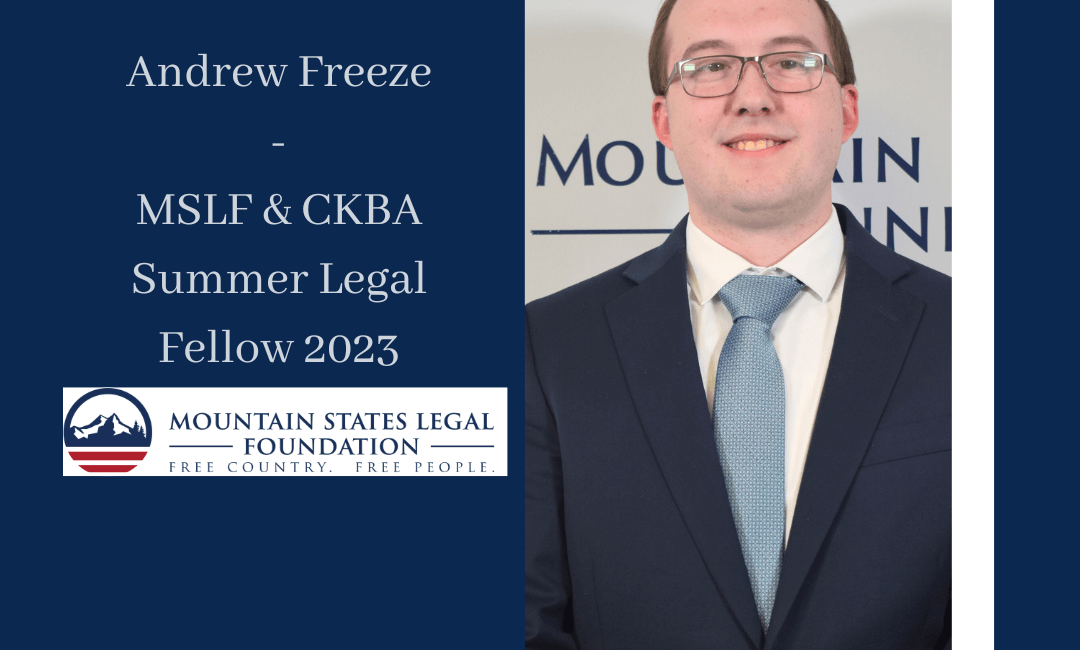
By Andrew Freeze, MSLF Summer Fellow
My name is Andrew Freeze. This summer I was a legal fellow here at Mountain States Legal Foundation. As a rising third-year at the University of Wyoming’s law school, working alongside professional attorneys on important work was an outstanding opportunity. I really want to thank Professor George Mocsary of the UW College of Law for creating the connection with Mountain States and for making this opportunity available to me.
Memos and Letters
From memos to letters to an amicus curiae brief to the Supreme Court of the United States, I definitely felt like I got some great legal experience this summer. At the beginning of the fellowship, I jumped right in with a formal memo about the Administrative Procedure Act’s remedy process and the court’s limitations regarding those remedies. The APA is a big deal for a lot of what Mountain States does, but I found the better part of the experience was working alongside David McDonald, who really took the time to give me amazing feedback. He helped turn my memo from something mediocre into something that I could rely on as a professional document.
After the memo, I was brought onto Mountain States’ letter to the University of California, Berkeley School of Law about their choice to hire Chesa Boudin. Boudin is a troublesome selection for Berkeley’s Criminal Law and Justice Center, and I had an engaging time highlighting how the hiring decision may likely undermine and even quell open dialogue about the Second Amendment at Berkeley. As a law student, I had a unique perspective to offer how faculty and staff have a huge impact on what students are comfortable saying without threat of unfair chastisement.
Fun with Chevron
One project legal fellows are assigned is extensive research on a topic of our choice that will go directly into writing an amicus curiae brief. After looking through the scope of Mountain States’ cases, I settled on the Chevron deference case. Chevron v. Natural Resources Defense Council was a case decided in 1984 that has been used repeatedly by courts to defer to agency judgements in cases where a law’s language (often vague and ill-defined) is being used as the justification for agency action. In the case of Loper Bright Enterprises v. Raimondo, fishermen in the Northeast are being forced by the National Marine Fisheries Service (NMFS) to pay for monitoring out of their own pockets, and the NMFS is using the Chevron deference doctrine to justify its policy.
The issue, as Mountain States sees it and wrote in our amicus, is that the Chevron doctrine is not actually a binding precedent. Instead, Chevron should be treated as a “canon of construction,” which is a fancy way of saying the courts should only defer to an agency’s interpretation of a law’s language if the court itself cannot first determine the law’s meaning on its own. To automatically defer to agency interpretations only adds to the ever-expanding bureaucratic state, and it undermines the constitutional powers of the judiciary.
As you might have guessed from that rather extensive summary on Chevron, I spent a lot of time on this project and was very happy to be a part of Mountain States’ effort to do some real good. The brief is going to the Supreme Court, so you can also count me proud for being a part of the work. On the whole, this summer I was exposed to research that is not common and can set me apart from the competition as I begin to job search this fall.
Good People
To say I met some great people while working at Mountain States would be an understatement. The legal team is incredibly supportive and were always willing to put the time in to make sure I was making improvements throughout the summer. I was also exposed to some of the work on the other side of the office at development and communications. Getting to see how a non-profit, public interest law firm operates is not something every law student gets to do, and I think it made my fellowship more well-rounded than if I was at a traditional firm, and is another piece that I feel sets apart the Mountain States fellowship experience.
For anyone else thinking of becoming a fellow, I want to say this: I got to feel as though I was included in the very mission of Mountain States and take an active part in furthering it. From advocating for Second Amendment rights to ensuring that the executive branch is not exceeding its authority through overzealous agencies, it felt good to fight for the constitutionally protected rights of Americans—rights that seem to be constantly under attack in today’s world.
My time at Mountain States offered me more than I could have hoped for in the short 12 weeks that I was here, and I would definitely invite any first or second years to strongly consider a legal fellowship here for their own summer experience.