
In an era when the integrity of the democratic process is constantly scrutinized, the case of Advance Colorado v. Griswold stands as a pivotal legal battle over the right to free speech and the preservation of genuine citizen-driven democracy. In this case, the core issue revolves around the clash between government-compelled speech and citizens’ ability to promote tax initiatives effectively. Advance Colorado, a nonprofit committed to reversing harmful policies and restoring common-sense values, fights to protect the very essence of voter autonomy. Advance Colorado argues that the government’s requirement to include specific statements on their ballot initiatives undermines their efforts and restricts their ability to advocate for the policies they support. This case will have far-reaching implications for the First Amendment and the future of direct democracy in Colorado and beyond.
Case Summary
Colorado’s state constitution provides for limited avenues of direct democracy. Key among those avenues is citizen initiative ballots, empowering ordinary citizens to propose and vote on laws or constitutional amendments independently of the legislature. This process allows citizens to take the reins of their governance, ensuring that their voices are heard without interference from elected officials. However, the integrity of this democratic process is under threat in Colorado, where the government has imposed ballot title requirements that distort the intent and impact of citizen-initiated petitions, particularly those concerning tax initiatives.
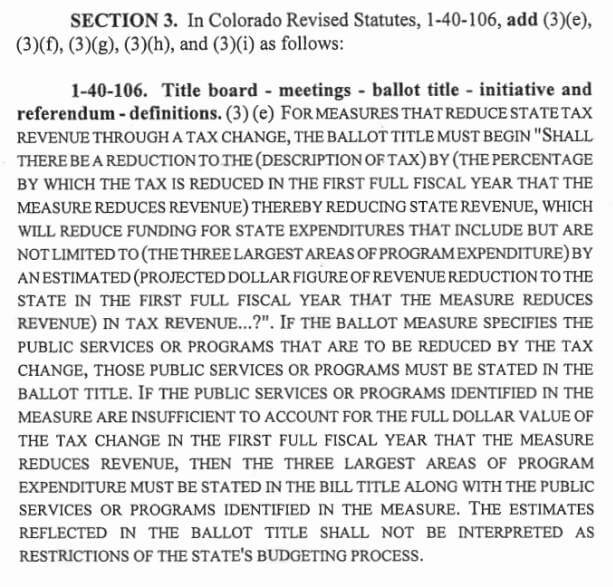
Under Colorado’s House Bill 21-1321, the state legislature attempted to stop this citizen-led democratic end-around the legislature’s power by demanding that the Secretary of State follow a fill-in-the-blank title form for each initiative. You’d think that would make things less prone to biased language. However, that assumes that the template is not, itself, biased.
Join the Fight
Since 1977, MSLF has fought to protect private property rights, individual liberties, and economic freedom. MSLF is a nonprofit public interest legal foundation. We represent clients pro bono and receive no government funding. Make your 100% tax deductible contribution today and join the fight.
Since its passage in July 2021, the citizens of Colorado have borne witness to these titles, framed by the government, containing more and more misleading information designed to influence and even trick voters.
By leveraging the government speech doctrine —a legal principle that allows the government to promote its own views, even false ones— Colorado has found a loophole to insert its narrative into the ballot process, effectively compelling speech from the citizens, advancing the initiative and forcing them to use state-mandated titles.
In this case, Colorado’s government is compelling Advance Colorado to include a statement on their tax ballot initiative, specifying the top three areas of government funding that might face reductions if the initiative subsequently passes. This forced disclosure is intended to manipulate public perception by highlighting speculative and even unlikely negative consequences. The government is undermining the initiative’s campaign and infringing on Advance Colorado’s right to free speech by compelling them to communicate a message they do not support.
These proscribed ballot titles directly impact Advance Colorado’s efforts to advocate for lower taxes and limited government. Mountain States argues that the mandated language misinforms voters and undermines the fundamental democratic process.
To determine what speech falls within the government speech doctrine, the Supreme Court created a guideline that lower courts can follow at their discretion. The factors include (1) the history of the medium in question, (2) public perception of whether the message belongs to the individual or the government, and (3) the government’s control over the message.
Here, the Tenth Circuit Court upheld that these ballot titles fall under this doctrine, effectively giving the government unfettered control over the messaging of citizen initiatives. However, we know that this application of the doctrine is a dangerous overreach, infringing on citizens’ rights to communicate their messages without governmental interference.
The misleading nature of these ballot titles is particularly harmful in the context of tax initiatives, where the language used by the government can significantly sway public opinion. These government-imposed ballot titles directly violate the First Amendment as they constitute compelled speech. The First Amendment protects individuals from being forced to convey messages they disagree with, especially in political speech. By presenting deceptive information, the government infringes on the petitioners’ right to free speech and undermines the voters’ ability to make informed decisions. This case highlights a political attack on fiscally responsible citizens who seek to influence tax policy through constitutional, democratic means.
Mountain States took up this case, alongside co-counsel Greenberg Traurig, to defend all Americans’ First Amendment rights and protect the integrity of the democratic process. The government should not be able to interfere with citizen-led initiatives by imposing biased or misleading language on ballot titles.
Mountain States filed a petition for a writ of certiorari, asking the Supreme Court of the United States to take the case and limit the application of the government speech doctrine, ensuring that it only applies when the government is the sole author of a message. This would protect the rights of citizens and organizations like Advance Colorado to advocate for their causes without unwarranted government interference. Ultimately, we seek a ruling that upholds the principles of free speech and direct democracy, ensuring that the people’s voice remains central in the democratic process.
What’s at Stake
The outcome of this case will determine whether Advance Colorado can effectively continue its mission to advocate for tax reforms and other initiatives aligned with their vision of limited government and individual liberty. If the government is allowed to dictate misleading language on ballot titles, Advance Colorado’s ability to gain voter support for its initiatives will be severely compromised, threatening its broader goals.
Beyond the specific implications for Advance Colorado, this case carries significant consequences for the broader democratic process. If the ruling in favor of Colorado Secretary of State Griswold stands, it sets a precedent that allows the government to manipulate voter perceptions at the most crucial moment—just before they cast their vote. This undermines the principle of free speech and endangers the foundation of direct democracy, where citizens have the right to propose and vote on laws without undue influence.
Unfortunately the Supreme Court denied our petition for certiorari in this case on February 24, 2025.