Case Summary
Radical environmentalists claim that if bighorn sheep and domestic sheep live within any proximity of each other, there is an overwhelming risk that domestic sheep will pass on diseases to the bighorns. Therefore, they claim any domestic sheep grazing throughout bighorn range has to be shut down to prevent such contact from potentially occurring, regardless of management practices. For this reason, the outcome of this case could very well determine the future of the sheep industry in the Southern Rockies.
Join the Fight
Since 1977, MSLF has fought to protect private property rights, individual liberties, and economic freedom. MSLF is a nonprofit public interest legal foundation. We represent clients pro bono and receive no government funding. Make your 100% tax deductible contribution today and join the fight.
Case History
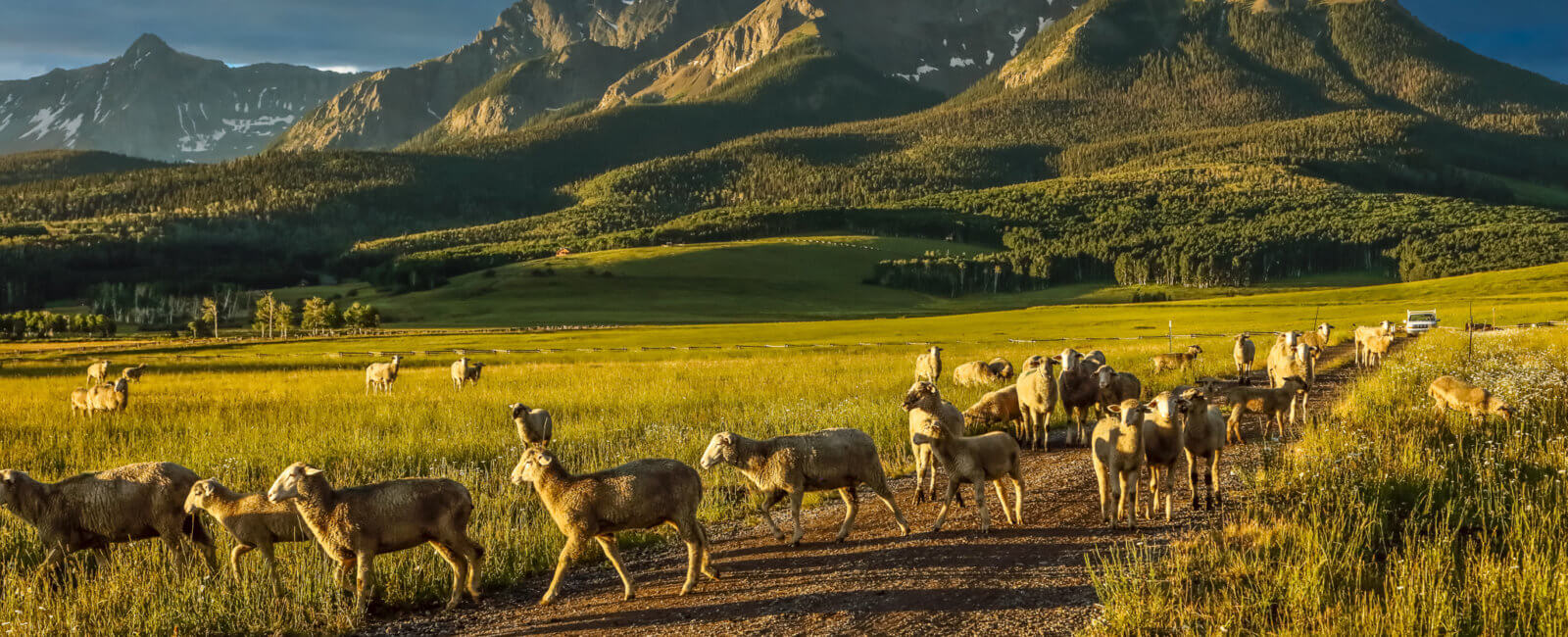
J. Paul Brown is a sheep rancher with a strong record of stewardship of the land and community involvement. Paul holds a federal grazing permit for several allotments in the San Juan National Forest. It’s there that he grazes his sheep under the towering Colorado Rockies. It’s his livelihood. It’s his life. But radical environmentalists are determined to drive him and his neighbors off the land and destroy everything he’s worked for.
This lawsuit was brought by Western Watersheds Project and WildEarth Guardians. Both groups are notoriously litigious. WildEarth Guardians frequently uses the Endangered Species Act to tie-up any sort of land management activity in federal court for years on end. Some of their other tactics have historically included outbidding ranchers on grazing leases to shut down allotments. Western Watersheds Project is probably the most infamously anti-grazing organization in the United States. While most similar groups portray themselves “fighting for the environment,” WWP is open about the fact that they want to destroy public lands grazing. If you read statements made by WWP’s founder, Jon Marvel, you would be astonished at how genuinely vicious some of his remarks are.
Several years ago, in Idaho, environmentalists used the pretext of a risk to bighorn sheep caused by domestic sheep grazing to achieve a devastating victory against ranchers—the very people who form the backbone of this country. Now, these same environmental groups are hoping to repeat in Colorado what they accomplished in Idaho.
Colorado rancher J. Paul Brown turned to Mountain States Legal Foundation for help. We are fighting for him because radical environmental groups should not be allowed to impose their agenda on western communities and put rural ranchers out of business.
For J. Paul, like thousands of other ranchers, this case will determine whether he can continue to graze his sheep on federal land. It will determine whether he can make a living and live the life he knows and loves.
We are also representing the Colorado Farm Bureau Federation (CFB) in this case. The CFB is the largest agricultural non-profit membership organization in the State of Colorado, representing the interests of nearly 25,000 ranchers, farmers, and other industry professionals in every county in the state. CFB was founded in 1919 and is dedicated to preserving and protecting the future of Colorado agriculture and rural values and to protect the western way of life.
In March 2020, U.S. District Court Judge Robert E. Blackburn granted MSLF’s motion to intervene on behalf of J. Paul Brown and the Colorado Farm Bureau.
“Addressing the interests of J. Paul Brown and members of the CFB in grazing allotments near the Wishbone Allotment, I find that it is possible — if not probable — those interests will be impaired if intervention is denied,” Judge Blackburn wrote.
The radical environmentalists claim that the Forest Service violated the National Environmental Policy Act (NEPA). But the NEPA does not require a specific outcome; it only requires that an agency perform an adequate analysis of the environmental impacts of an action it proposes. Here, the Forest Service satisfied its legal requirement to take a “hard look” at the impacts of allowing sheep grazing in the Rio Grande National Forest and did a thorough analysis of all relevant factors. By law, courts must be deferential to an agency’s conclusions, especially with highly technical scientific analysis such as the Forest Service performed.
Local ranchers and Forest Service officials understand that proper livestock management is capable of mitigating the theoretical risk of disease transmission to bighorn sheep. But the radical environmentalists believe that they know better. They will not stop until they have imposed their will on the people of Colorado, just as they did in Idaho.
“A common strategy among environmental groups is to choose a species with a large geographic distribution for their lawsuits in order to shut down as much access and productive use of natural resources as possible,” says Brian Gregg, our lead attorney on the case. “Think of the sage grouse or the spotted owl.”
This case could start the dominos falling throughout the western U.S. If we do not defeat the radical environmentalists, ranching could be prohibited on significant portions of land in the Southern Rockies. Ranchers and their communities would be devastated economically.
He intends to keep ranching for a few more years and hopes one of his children or grandchildren will take over for him.
“I want to pass that legacy on, ” he told the Pine River Times. “But they have to be able to make a living.”
On March 8, 2024, Mountain States received a victorious ruling from the District Court of Colorado stating, “The Court finds that the [U.S. Forest] Service’s actions were not arbitrary, capricious, an abuse of discretion, or otherwise not in accordance with law, and that the Service did not violate NEPA or the APA.”
On April 3, 2024 Wildearth Guardians decided to appeal our victory to the Tenth Circuit Court of Appeals.
On March 18, 2025, oral argument was held before the Tenth Circuit Court of Appeals in Denver, Colorado.
May 2025 Update
Unfortunately, on May 9, the Tenth Circuit decided that it would decide things differently than the Forest Service and the Federal District Court did in our Bighorn Sheep case. In the case, the US Forest Service used logic to fill a few spaces where Colorado regulators wouldn’t provide evidence. The Federal District Court reviewed the case and agreed that it was reasonable to create the Wishbone Allotment for grazing sheep, which was the decision that was challenged. But the Tenth Circuit ignored the Federal District Court’s analysis and decided that it would have made a different decision, as if it was the federal regulator all along. Rather than clean up the mess it created, the Tenth Circuit decided that while it was comfortable flyspecking the decisions that would allow grazing, it didn’t want to be on the hook for actually cleaning up the mess it made. So, the Wishbone Allotment still is in place—and we consider that a victory—but our clients have no clear guidance from the Tenth Circuit about whether they can ranch out there or not.

