
Case Summary
Former Colorado Corrections Sergeant Josh Young is suing the Centennial State over divisive and bigoted “Diversity, Equity and Inclusion” training that created a hostile and discriminatory workplace, further ratcheted-up racial tensions in the prison, and recklessly undermined the morale, cohesiveness and safety of the facility’s guard force and inmate population.
Join the Fight
Since 1977, MSLF has fought to protect private property rights, individual liberties, and economic freedom. MSLF is a nonprofit public interest legal foundation. We represent clients pro bono and receive no government funding. Make your 100% tax deductible contribution today and join the fight.
Case History
While growing up as a blue-collar kid in Southern California, Josh Young dreamed of one day being a cop. But when work as a corrections officer became available in his adopted state of Colorado, he answered the call to serve, quickly rising through the ranks in one of Colorado’s roughest state-run prisons.
Josh was proud to serve as a corrections officer. But the decision drew Young into a prison environment that’s often even more tense, dangerous, high-risk, and racially-charged than what the average police officer confronts on the streets.
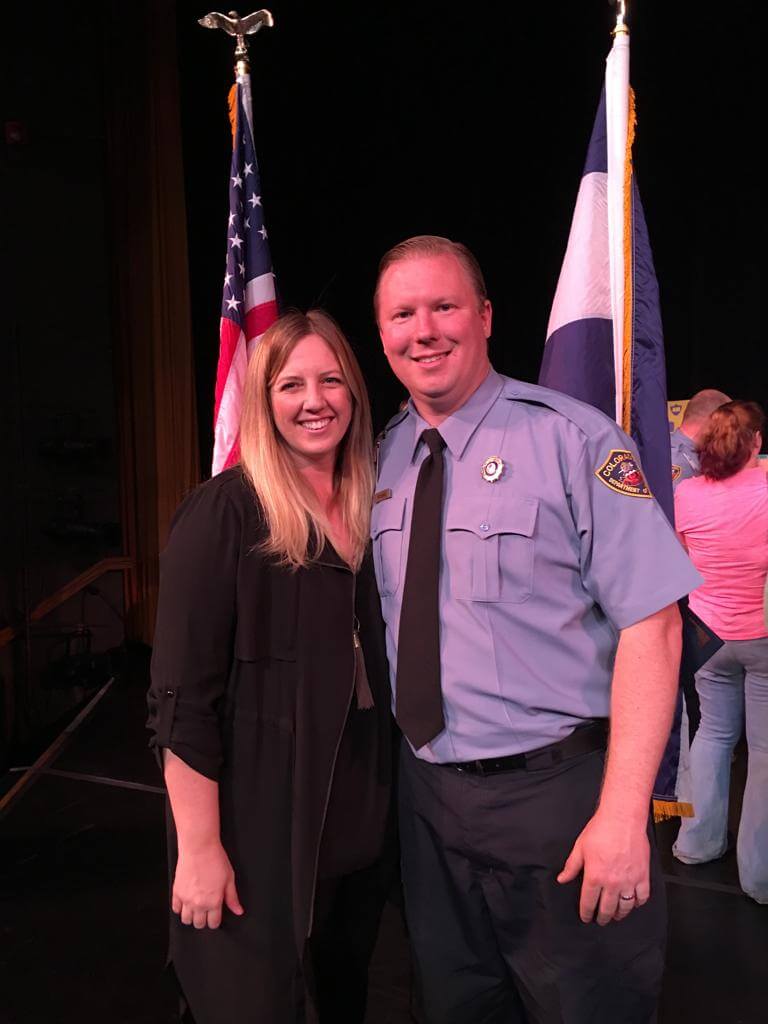
Worse, the guards at the Limon Correctional Facility were unnecessarily placed at even greater risk when the state of Colorado mandated new training for officers that exacerbated the very kind of racist thinking and racial attitudes inside the razor wire that were already one challenge of Josh’s job.
This not only violated Young’s legal right to a discrimination-free workplace – it also put the safety of everyone working at or serving time at the facility at a heightened risk of race-based tensions, turmoil, or violence. It appeared to Sgt. Young that the state of Colorado was unnecessarily and recklessly throwing gasoline on a fire, given the racial divisions and tensions already pervasive among inmates. And he feared that the unity, cohesiveness, and morale of the prison guard force would suffer, putting everyone in the facility at greater risk, when state-sponsored racial thinking and indoctrination permeating its ranks as well.
“The prison, unfortunately, is a really racially charged place,” explains Young, with inmate gangs and groups divided along racial lines, which just raises the normal dangers and tensions one would expect in that world. The guards, by contrast, were very diverse but also very unified. “We had great camaraderie and teamwork between us,” according to Young. Without that unity, the world inside becomes an even more perilous place to live and work.
The training imposed by the state worried Young not just because of the false and divisive messages that the guards were being asked to endorse, but due to the dangerous disunity that it could sew among guards and other corrections personnel.
“Here, the state is coming in and insisting that we can’t do our jobs without seeing people through the lens of skin color,” says Young. “The message being delivered is that we can’t trust each other to overcome our skin color, which to me seems like a very superficial thing to have to overcome.”
Until this turning point, Young was a rising star at the Colorado Department of Corrections. He was one of the first employees promoted from his graduating class, advancing to the role of Corrections Officer at Limon Correctional Facility in 2017. Shortly after, in 2019, he served as a Housing Sergeant in a close custody unit, running one of the most difficult prison units in the State of Colorado. In 2020, he began serving as a Visiting Sergeant, a position in which he screened visitors and ensured the safety of both visitors and prisoners during visitation periods. In short, his job depended on making good decisions and not treating situations, inmates, or visitors differently on the basis of their skin color.
Unfortunately, the Colorado Department of Corrections had different ideas. State mandated training, provided under the auspices of “Equity, Diversity, and Inclusion” training, created working conditions that were insulted Caucasians and demeaned him as a white supremacist. Josh was ultimately forced to resign after his employer refused to even investigate his allegations of discrimination.
Young was subjected to hostile work environment discrimination under Title VII of the Civil Rights Act of 1964, 42 U.S.C. § 2000e, et. Seq, which makes it unlawful for an employer “to discriminate against any individual with respect to his compensation, terms, conditions, or privileges of employment, because of such individual’s race, color, religion, sex, or national origin.”
However, the Colorado Department of Corrections implemented mandatory trainings that made sweeping negative generalizations regarding individuals who are white.
For instance, the official training stated that all white individuals are racist, that the concept of race was invented by white people to justify oppressing non-whites, and that if a white individual denies their part in white supremacy, that is merely evidence of their “white fragility.” Other documents promoted by Colorado noted that training leaders needed to watch out for “white norms” and “White Talk” when running discussion groups.
These trainings forced Mr. Young to hear and absorb statements that were facially based on race. These training sessions were also part of a series of annual training obligations, and thus, absent any changes, would reoccur the next year, and in following years. And of course, prison guards are expected to live up to their training—to implement it faithfully, in order to succeed and advance in the workplace.
For instance, portions of Young’s training included:
A glossary of terms which defined “BIPOC” to mean: “Acronym for Black, Indigenous People, and People of Color; the term is used to acknowledge that Indigenous and Black people have been most impacted by whiteness, both historically and in the present day. This shapes the experiences of and relationship to white supremacy for all people of color within a U.S. context.”
The same glossary also includes the definition of “White Fragility”: “Discomfort and defensiveness, often triggered by feelings of fear or guilt, on the part of a white person when confronted by information about racial inequality and injustice.”
Similarly, the training involved a section on “Other Tools & Resources” that employees were strongly encouraged to watch and read. These “resources” also contained troubling and racist statements. For instance, in Redlined, A Legacy of Housing Discrimination, one of the interviewees uses the full N-word, placing it in the voice of all individuals other than African-Americans. “The concept of a middle-class black only exists in the mind of a middle-class black,” someone says on the video. “Everywhere else in the suburbs, you were that [N-word] family on the corner Warren Road and Boulevard Way.”
The same video accuses all white individuals of misunderstanding that whatever success they had as a result of their own merit, as opposed to the simple product of past forms of race discrimination. One quote from the video is as follows: “Well the truth is that we’ve had in this country generations of affirmative action for whites, and the sad truth of it is that whites don’t know that that’s happened or they’ve refused to accept it, or don’t understand the history,” What that leads to is this false kind of narrative [for whites] that ‘I did it myself.’
The environment of division and distrust these trainings seem designed to foster would be unlawful in any setting. But in a prison context, they were downright deadly.
The Limon Correctional Facility is a razor-wired prison full of racially segregated gangs and hardened criminals, who always are looking to sew further division and make life harder on the corrections officers. In this environment, divisive state-sponsored racial indoctrination put the lives and safety of inmates and guards at greater risk. That’s why Young felt he had to leave a job that he otherwise greatly valued, and pursue a lawsuit in response to the dangerously hostile, racially-fraught situation the state of Colorado is creating at its Limon Correctional facility.
Recent Developments
Josh’s case was initially dismissed in February 2023. But MSLF appealed to the Tenth Circuit Court of Appeals. In March 2024, the Tenth Circuit recognized that this type of race-based training rhetoric is “troubling on many levels” and “sets the stage for actionable misconduct.” The court noted that such trainings can “promote racial discrimination and stereotypes within the workplace” and “encourage racial preferences in hiring, firing, and promotion decisions.”
And now, Young has been able to use the Tenth Circuit’s analysis in his amended complaint, which details how the EDI training created a hostile environment that unreasonably interfered with his work performance, and ultimately compelled him to resign.
“State-sponsored racism is never appropriate,” said MSLF General Counsel William E. Trachman. “Josh was forced to listen to bigoted official training telling him that he was a racist and white supremacist because of the color of his skin, and that his daily actions contributed to white supremacy. Colorado’s prisons are worse off, and the state is worse off, because of this training.”
Added Trachman: “Josh’s job depended on treating prisoners, visitors to the prison, and his colleagues equally, without regard to race. Forcing him to listen to official training that called him a racist and white supremacist drove a wedge between himself and his job duties, and made the prison environment toxic and dangerous.”
What’s At Stake
For Josh Young, the racially discriminatory and hostile work environment created by the Colorado Department of Corrections’ mandatory EDI training not only violated his legal rights, but also jeopardized his safety, his relationships with colleagues, and his ability to effectively carry out his duties as a corrections officer. The training’s divisive and inflammatory content ratcheted up racial tensions in an already charged prison setting, endangering both staff and inmates.
More broadly, this case represents a critical battle against the rising tide of state-sponsored racism and the erosion of individual liberties. By forcing employees to endorse and apply racially discriminatory concepts, the Colorado Department of Corrections is not only violating the Constitution, but also undermining the very principles of equality, essential to a just society.
Mountain States Legal Foundation is committed to defending Josh Young’s rights and holding the Colorado Department of Corrections accountable for its actions. We are fighting to ensure that no employee, whether in the public or private sector, is subjected to a hostile work environment based on race. This case has far-reaching implications for the future of race relations, individual freedom, and the rule of law in America.
A victory for Josh Young would send a powerful message that state-sponsored racism will not be tolerated and that those who promote discriminatory ideologies under the guise of “diversity, equity, and inclusion” will be held accountable. It would also set a precedent for challenging similar training programs in other government agencies and private companies across the country.
Case Timeline
- February 2021: Colorado Department of Corrections announces mandatory EDI training for all employees.
- March 2021: Josh Young completes EDI training and experiences an ongoing hostile work environment.
- July 6, 2021: Young files internal complaint with the Colorado Department of Corrections, which is dismissed without investigation.
- July 8, 2021: Young submits resignation notice due to intolerable working conditions.
- July 13, 2021: Young files complaint with the Equal Employment Opportunity Commission (EEOC).
- January 19, 2022: Young files initial lawsuit in U.S. District Court for the District of Colorado.
- February 3, 2023: District Court dismisses Young’s complaint without prejudice.
- March 1, 2023: Young appeals dismissal to the U.S. Court of Appeals for the Tenth Circuit.
- March 11, 2024: Tenth Circuit affirms dismissal but recognizes potential for hostile work environment claim based on race-based training.
- June 3, 2024: Young files amended complaint in U.S. District Court for the District of Colorado, detailing severe and pervasive hostile work environment created by EDI training.
- April 23, 2025: MSLF submits its opening brief to the United States Court of Appeals for the Tenth Circuit.
- January 22, 2026: MSLF argues before the United States Court of Appeals for the Tenth Circuit.