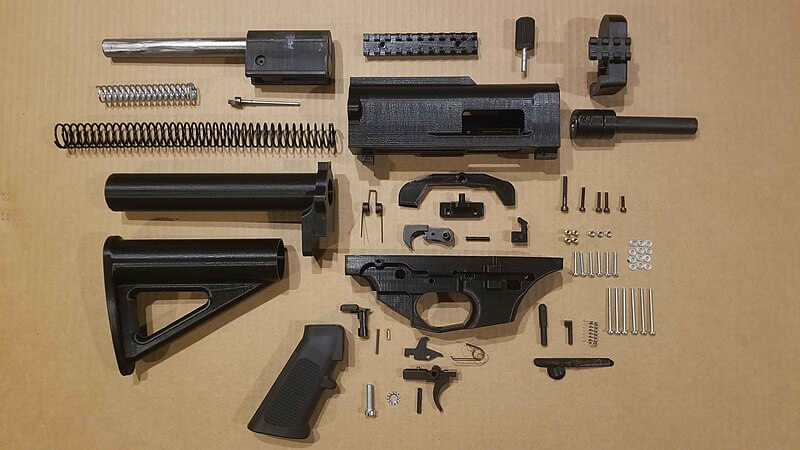
Self-reliance is one of the crown jewels of the American spirit. Forging the Western Frontier was a matter of having the ability and confidence to be independent, both from faraway governments and distant corporations. Whether one was farming, traveling, hunting, or building a home, the very utterance of “Go west, young man” evoked the call to be autonomous and self-sufficient.
Part of that proud tradition, predating the founding of our nation and the framing of our Constitution, is the right to self-manufacture firearms. Before the modern culture of control, Americans looked to themselves to make their guns. The ability to build, repair, or customize guns allowed early Americans to defend their communities, and eventually to fight and prevail in the Revolutionary War.
Mike Andren, a retired aerospace engineer and firearms instructor, and Jennifer VanDerStok, a writer for a small local magazine and a former law enforcement officer, continue that tradition today. They have embraced the American spirit of independence, and the practice of crafting their own tools of self-defense. Of course, the government hates that and is trying to stop Mike, Jennifer, and every other peaceable American from exercising their rights. That’s why Mountain States Legal Foundation is representing them in their fight to keep and bear arms.
Case Background
Before the mass production of firearms, the practice of self-manufacture was correctly understood as belonging to the natural right of self-defense. The right to craft and customize firearms enables us to determine which arms we will “keep and bear”—and it ensures that we have access to arms without dependence on a government-approved set of suppliers. Thus, the right of self-manufacture is among the natural rights that came under explicit protection when the Second Amendment was adopted.
Technological changes don’t change our rights, and the American People still have a constitutionally protected natural right to craft and customize guns. But gun control activists and anti-gun politicians have become focused on suppressing this right—especially through use of the misleading term “ghost guns,” a derogatory label. Their intent is to tarnish the good reputation of peaceable citizens like Mike, who have dedicated themselves to helping others be self-sufficient and confident in their abilities to defend themselves, or Jennifer, who protected our community for eight years in law enforcement.
Giving in to pressure from both activists and President Biden, the Department of Justice and the Bureau of Alcohol, Tobacco, Firearms and Explosives (ATF) decided, in a new rule issued April 2022, to dramatically exceed their authority and violate congressional intent.
This Final Rule, addressing the “Definition of ‘Frame or Receiver’ and Identification of Firearms,” alters the legal landscape surrounding firearms regulation, giving complete discretionary power to the ATF and its Director to decide what the ATF can regulate and how. The ATF is usurping Congress’s legislative power and is wielding the regulation to severely burden the practice of self-manufacture and the businesses that facilitate it.
Join the Fight
Since 1977, MSLF has fought to protect private property rights, individual liberties, and economic freedom. MSLF is a nonprofit public interest legal foundation. We represent clients pro bono and receive no government funding. Make your 100% tax deductible contribution today and join the fight.
What’s at Stake
Americans have a natural, constitutionally protected right to make and craft firearms for self-defense—a practice that will be severely restricted by these new federal regulations and their chilling effects. The ATF’s Final Rule wrongly defines many inert objects as “firearms,” and its incomprehensible regulations will have a chilling effect on those who seek to exercise the natural right to manufacture firearms.
As MSLF attorney Kaitlyn Schiraldi said, “Making and crafting firearms is a practice older than our Constitution, and personally manufacturing firearms is an essential part of our natural right to defend ourselves. Jennifer is not just asking to exercise her Second Amendment rights. She’s demanding to exercise her rights that come before any human institution.”
Americans also have a system of government in which the president is elected to enforce the laws made by Congress, not to make new laws by dictating to compliant bureaucrats. The ATF’s actions are done purely by executive decree through federal agency rulemaking and “adjusting” its interpretation of congressionally passed law.
MSLF attorney Erin Erhardt said, “The President isn’t a lawmaker and thus cannot use the federal bureaucracy to sidestep Congress. He can’t just make a rule to enact his anti-gun agenda when no congressional law permits or contemplates such an agenda. The Final Rule is an attempt to bludgeon the Constitution and intimidate peaceable Americans from exercising their rights. It’s reprehensible for any president to do this on any issue, but especially when it involves the natural right to protect our lives and our loved ones.” The ATF’s Final Rule sets a dangerous precedent that threatens the separation of powers our Constitution requires.
Finally, the Final Rule violates the First Amendment as well. Under the new regulations, the ATF would be allowed to assess the content of instructions, guides, and marketing materials of gun parts to determine if a product is a firearm. The issue with such a process is that instructions, guides, and marketing materials are all covered under the First Amendment as speech. The Final Rule’s review process would be tantamount to content-based and speaker-based restrictions on speech by a government agency.
Case Timeline
The Center to Keep and Bear Arms (CKBA) submitted comments objecting to the Proposed Rule in August 2021, in which CKBA warned the ATF that the proposed version of its new rule lacked “any recognition of the rights of the American people, any respect for the rule of law, any acknowledgment of limits of the ATF nor Department of Justice’s statutory authority, or any attempt to uphold the duty of agencies entrusted with the enforcement of criminal law to ensure that the enforcement of that law is not ill-defined and arbitrary.” CKBA is also involved in two cases that preceded ATF’s change in position on self-manufacture and the definition of a “firearm” (Syracuse v. ATF and California v. ATF).
The problems that CKBA warned of remain present in the Final Rule. In August 2022, Jennifer and Mike, along with Tactical Machining, LLC—represented by CKBA and the Firearms Policy Coalition—sued the Department of Justice and ATF in federal court, opposing the assault on Americans’ right to self-manufacture firearms.
- September 2, 2022: Judge Reed O’Connor ordered a preliminary injunction for Tactical Machining
- October 1, 2022: Judge O’Connor expanded the preliminary injunction to include Tactical Machining’s customers, Jennifer VanDerStok, and Mike Andren
- November 3, 2022: The ATF appealed to the 5th Circuit Court of Appeals regarding the preliminary injunctions. The merits of the case must still be decided at the district level.
- December 23, 2022: Mountain States filed a motion for summary judgement in the district court, asking the judge to rule on the merits of the case in favor of our clients.
- June 30, 2023: Mountain States received a tremendous victory in the case as the judge sided with our clients in all matters.
- July 17, 2023: ATF appealed the decision made by US District Court for the Northern District of Texas and requested a motion to stay the decision.
- July 24, 2023: The Fifth Circuit Court of Appeals denied the ATF’s request to stay the decision.
- August 2, 2023: The ATF appealed to the Supreme Court of the United States to stay the decision made by the District Court of Northern Texas.
- August 8, 2023: The Supreme Court stayed the decision of the district court, and thus kept the ATF’s unconstitutional rule in place until the appeals process was complete.
- September 7, 2023: As a part of the appeals process, the Fifth Circuit Court of Appeals heard arguments on the case in light of the District Court’s decision in favor of Mountain States.
- November 9, 2023: The Fifth Circuit upheld the District Court’s decision to strike down the Final Rule but kept the regulation in place until the appeals process is exhausted.
- April 22, 2024: The Supreme Court granted the petition for cert in VanDerStok. We are headed to the Supreme Court!
- October 8, 2024: The Supreme Court heard oral argument on our VanDerStok case! We now await the court’s decision.
- March 26, 2025: The Supreme Court upheld the ATF’s Final Rule. In a 7-2 decision, the Court stated that the ATF had not necessarily exceeded its authority by regulating the building of firearms by private citizens, by including home kits in the definition of “firearm.” Instead, courts may evaluate cases of specific firearms kits, on an individual basis, to determine whether they count as “firearms.” Mountain States is disappointed that the Supreme Court did not recognize that the ATF’s 2022 expansion of its own authority was unlawful.
- May 2025: The Department of Justice is currently reviewing the Biden-era “Final Rule” after the issuance of the March 2025 Supreme Court decision.

